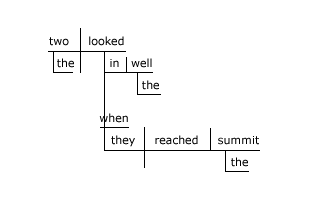
Number 1 – “Jack and Jill is a (compound) noun, two nouns linked by a coordinating conjunction, functioning as the subject of “went.” “went” is a verb functioning as the predicate. “up” is a preposition linking its object to the rest of the sentence. “hill” is a noun functioning as the object of the preposition. “up the hill” is a prepositional phrase functioning as an adverb and modifying “went.” “after” is a preposition linking its object to the rest of the sentence. “consideration” is a noun functioning as the object of the preposition. “careful” is an adjective modifying “consideration.” “after careful consideration” is a prepositional phrase functioning as an adverb and modifying “went.” “of” is a preposition linking its object to the rest of the sentence. “needs” is a noun functioning as the object of the preposition. “their” is a pronoun functioning as an adjective modifying “needs.” “of their needs” is a prepositional phrase functioning as an adjective modifying “consideration.”Number 2 – “two” is a noun functioning as the subject of “looked.” “looked” is a verb functioning as the predicate of the first clause. “in” is a preposition linking its object to the rest of the sentence. “well” is a noun functioning as the object of the preposition. “in the well” is a prepositional phrase functioning as an adverb modifying “looked.” “they” is a pronoun functioning as the subject of “reached.” “reached” is a verb functioning as the predicate of the second clause. “summit” is a noun functioning as the direct object of “reached.” “The two looked in the well” is an independent clause. “when” is a subordinate conjunction linking the dependent clause to the independent clause. “when they reached the summit” is a dependent clause functioning as an adverb modifying “looked.”Number 3 – “children” is a noun functioning as the subject of “fell.” “Jack and Jill is a (compound) noun functioning as an appositive to “children.” “fell” is a verb functioning as the predicate of the first clause. “down” is a preposition linking its object to the rest of the sentence. “hill” is a noun functioning as the object of the preposition. “down the hill” is a prepositional phrase functioning as an adverb modifying “fell.” “For” is a preposition linking its object to the rest of the sentence. “reason” is a noun functioning as the object of the preposition. “For a reason . . . “ is a prepositional phrase functioning as an adverb modifying “fell.” “which” is a (relative) pronoun, and therefore also a subordinate conjunction, functioning as the subject of “is” and linking the dependent clause to “reason.” “is” is a (linking) verb functioning as the predicate of the second clause. “apparent” is a predicate adjective modifying “which.” “immediately” is an adverb modifying “is.” “not” is an adverb modifying “immediately.” “which is not immediately apparent” is a dependent clause functioning as an adjective modifying “reason.”
The views and opinions expressed on individual web pages are strictly those of their authors and are not official statements of Grinnell College.
Copyright Statement.